
Cheap miniature roses: a bargain or a bad choice?
€2 pots, and a pleasant surprise
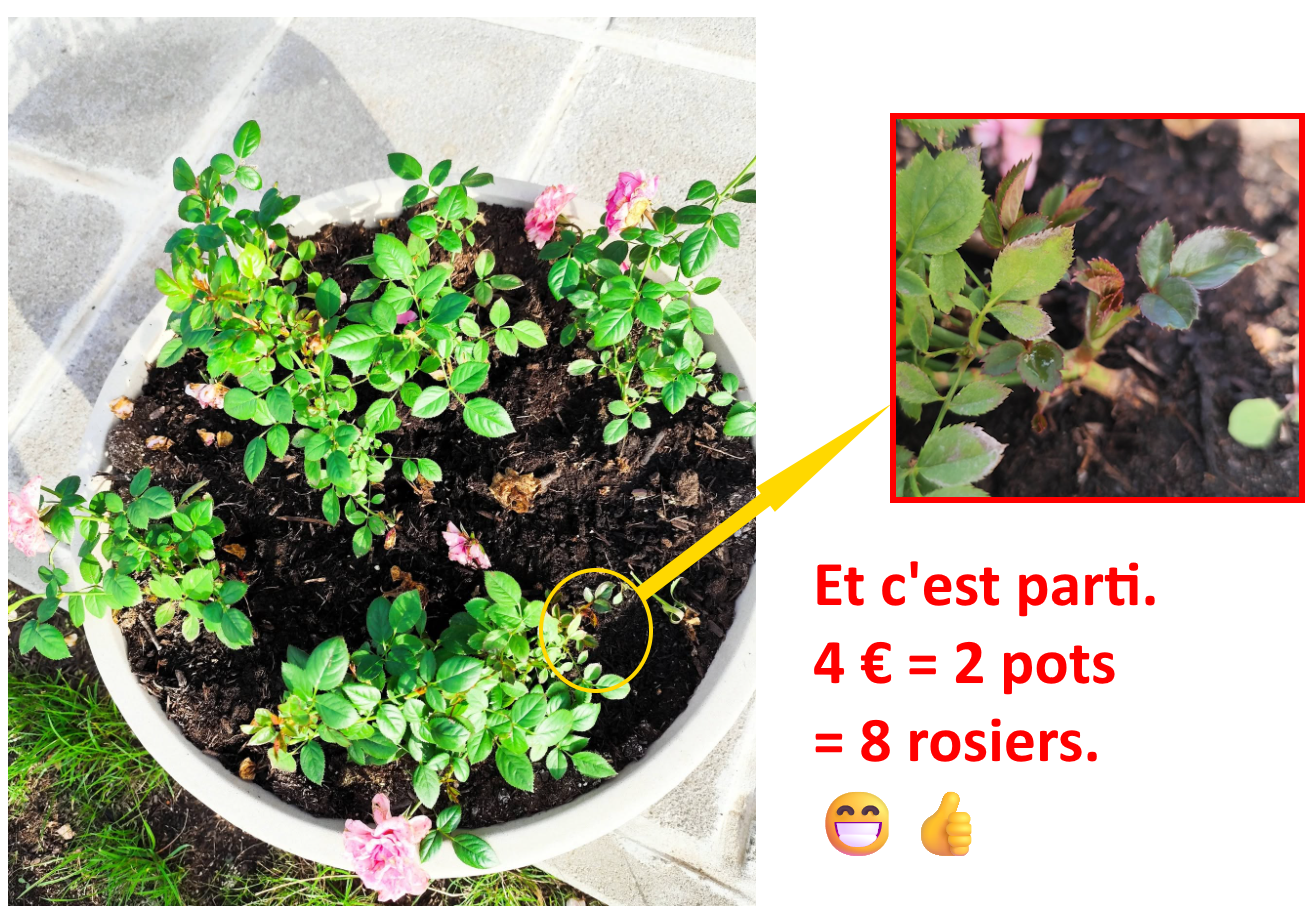
I walk past the garden aisle at Lidl, as I often do, without really looking for anything. And there they are: small pots of miniature roses, covered in flowers, at an almost ridiculous price. Impossible to resist, I take two. Back home, as I am repotting them into a large planter I intended to put on the terrace, I make a discovery: what I took for a single bushy rose per pot was actually four small cuttings, each rooted separately, planted tightly against each other. Two pots, so eight cuttings in total.
First reaction: have I been had? Two pots, one price each, and in fact eight plants for the price of two, packed like sardines. Second, calmer reaction: what if it was actually a good deal, as long as I looked after them properly?
I wanted to check rather than assume. And the answer is clear: it is a documented and fairly widespread horticultural practice, not a scam. I found the exact account of a gardener who had the same experience with this type of miniature rose: gently taking the root ball apart, he found four separate plants, each with its own roots. The growers' principle is simple: grouping several cuttings in a small pot gives a "dense, flowering bush" effect on the shelf, which sells much better than a single puny stem. So it is not a throwaway plant or a dishonest marketing trick at all — it is a production technique that, used well, can even become an advantage for those who know how to spot it.
Rather than keeping the cuttings grouped in fours as they were when I bought them, I chose to separate them straight away and spread my eight cuttings across one large outdoor planter, so that each one would have its own space to spread its roots from the start, instead of competing with three direct neighbours. Here is everything I put in place, and everything I checked, so that this "bargain" stays a bargain right through to flowering.
The planter: the real question is depth
We often think width before depth, and that is a mistake. I checked what the Royal Horticultural Society recommends for miniature and patio roses: a container depth of 23 to 35 cm. That is noticeably less than what you sometimes read online (some advice says 40 cm or more, without a source), and it is good news: no need for a monumental tub.
For eight young plants separated and spread out in the same container, I needed width: I went for a planter much more generous than a single original pot would need, around 60 cm in diameter, still with the same depth of 25 to 35 cm — depth does not change with the number of plants; it is the surface spacing that counts. And above all, a non-negotiable condition: drainage holes that really work. A rose dies far more often from drowning than from thirst. I checked that nothing was blocking the bottom and added a layer of a few centimetres of clay pebbles before the compost.
Separating them straight away rather than waiting has a cost: young roots, barely out of their original pot, do not like being handled. I went gently, with a moist root ball, teasing each cutting apart without tearing any roots, and replanting it immediately at the same depth as in its original pot, spacing the eight plants as far apart as the planter allowed.
Compost and position: sun is non-negotiable
A rose, even a miniature one, is still a rose: it is a full-sun plant. I placed my planter where it gets at least 5 to 6 hours of direct sun a day, favouring morning sun where possible rather than the harsher mid-afternoon sun — it dries the dew on the foliage and limits damp-related diseases from the outset.
For the growing medium, I made a mix that is rich but drains well: about half garden soil or loam, and the other half shared between rose compost (or good-quality multi-purpose compost) and well-rotted garden compost. Pure, light compost dries out too quickly in summer and does not hold nutrients long enough — with eight plants drawing on the same volume, that would guarantee endless watering.
Watering: regular, never waterlogged
This is the trickiest point in a planter, even more so with eight plants sharing the same volume of soil. My rule: I check the top two or three centimetres of compost with my finger before every watering. Dry on the surface, I water generously, at the base, never on the foliage, until water runs out of the bottom. Moist, I wait.
In summer, that can mean a daily check during heatwaves. The rest of the year, much less often — and in winter I cut back sharply without ever letting the root ball dry out completely. A light mulch (pine bark, dried grass clippings) on the surface limits evaporation and avoids sudden swings.
Feeding eight roses in the same planter
Eight plants in a limited volume of soil use up the reserves faster than a single rose in the ground. I set up a simple programme, with two Belgian products I checked before choosing them:
In spring, a dose of DCM Roses & Flowers granular fertiliser (NPK 6-4-10, enriched with magnesium), at the rate given on the pack for container growing — magnesium contributes directly to the green colour of the foliage, which is no small matter when trying to keep eight plants green in the same container.
From May to July, as a follow-up, a supplement of DCM Roses & Flowers liquid fertiliser (NPK 3-2-4, enriched with iron), diluted at 3–5 ml per litre of water as directed by the manufacturer, applied every two to three weeks.
From mid-August, I stop all nitrogen feeding: soft growth stimulated too late in the season will only be frosted at the first cold snap.
Reading the leaves: deficiencies to watch for
With eight roses in the same planter, I inspect them every week — that is where the first signs show, well before anything becomes a serious problem.
| Symptom observed | Likely deficiency | What I do |
|---|---|---|
| Yellow leaves with veins that stay green (especially on young shoots) | Iron chlorosis (iron poorly absorbed, often due to excess lime) | Iron chelate in the watering, rainwater if possible |
| Even yellowing of old leaves, weak growth | Nitrogen deficiency | Moderate nitrogen fertiliser or diluted nettle tea |
| Yellowing between the veins of older leaves | Magnesium deficiency | Diluted Epsom salts (magnesium sulphate), 2–3 times a season |
| Leaf edges browned, as if scorched | Potassium deficiency | A fertiliser richer in potash |
One point I keep in mind: yellowing is not automatically a deficiency. Too much water, a lack of light or a disease sometimes give similar symptoms. I always look at the whole plant before drawing conclusions.
Diseases and pests not to let settle in
Three adversaries keep coming back on container roses, miniature or not:
Aphids, on young buds in spring — a firm jet of water or a spray of diluted soft soap (one tablespoon per litre) is usually enough, and I am happy to let the ladybirds do the rest.
Powdery mildew, the white felt that appears in dry, muggy weather — I prevent it by keeping the foliage well aired (the eight plants must not form a completely closed block) and treat with sulphur if needed.
Black spot (Diplocarpon rosae, also known as Marssonina), the number-one rose disease — I always water at the base, never on the leaves, I pick up and remove spotted leaves as soon as I see them, and I keep Bordeaux mixture on hand for a preventive treatment in late winter if there is a history of the disease.
Pruning: the move that prolongs flowering
Nothing complicated: I remove faded flowers as I go, cutting just above a well-formed, outward-facing leaf — each cut like this triggers a new flowering shoot. In late winter, around February–March, a harder prune: I shorten the stems by about a third, keeping three to five buds per branch, and remove dead wood and stems crossing towards the centre.
Winter: the real area of uncertainty
This is the point on which I have remained most cautious. You sometimes read that miniature roses tolerate very hard frosts without trouble. That is broadly true for the "miniature rose" category established in the ground for several seasons — but my eight supermarket cuttings, on their own roots, still young and freshly transplanted and divided, have no such history. So I prefer not to promise anything about their exact frost resistance in the first year, and to protect them properly rather than gamble.
In practice: I mulch the surface of the compost generously before the first hard frosts, wrap the planter in horticultural fleece or bubble wrap, and move it close to a sheltered wall. I never bring the planter into a heated room: the winter rest is part of the rose's cycle, and dry indoor heat would exhaust it more than protect it.
My verdict: a bargain, if you play the game
So, good deal or bad calculation? With hindsight and after checking, I clearly lean towards the bargain — but a conditional one. A supermarket miniature rose for a few euros is actually four viable young plants per pot, not a fragile plant destined for the bin after flowering. The trade-off is that they share a limited volume of soil and, at least in the first year, need more attention than a rose planted on its own in the ground: a deep enough container, regular watering, steady but measured feeding, and real winter protection until they are well established.
I do not regret my purchase. My eight roses have begun their new life, separated and well spaced in their shared planter, and I fully intend to document what happens over the seasons.
