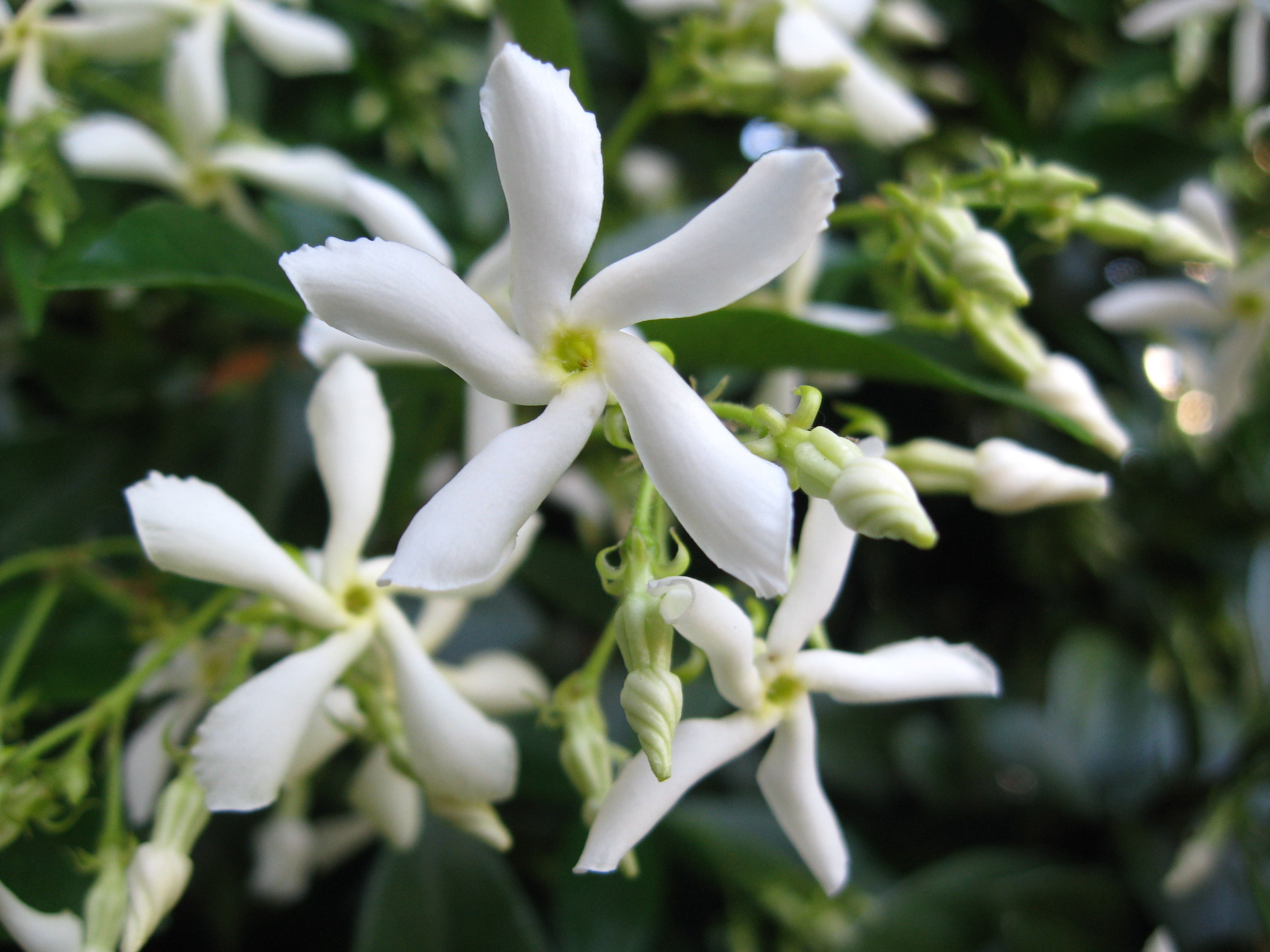
Trachelospermum jasminoides: Star Jasmine, a fragrant climber

Fragrant white flowers of Trachelospermum jasminoides|

🌿 Evergreen climbing plant β€” Hardy down to -15Β°C β€” Intoxicating jasmine-like fragrance

Biology and characteristics of Trachelospermum jasminoides

Family and classification

Trachelospermum jasminoides belongs to the Apocynaceae family (subfamily Apocynoideae), just like oleander or vinca.

It is a woody, evergreen climbing plant native to East Asia (China, Korea, Japan).

Its scientific name means "neck-shaped perianth" (trachelo-) and "rolled seed" (-spermum), referring to the shape of its flowers and seeds.

Morphological characteristics

  • Habit: Climbing vine that can reach 10 to 12 meters in height on a suitable support (walls, pergolas, trellises).
  • Leaves: Evergreen, oval to lanceolate, leathery, glossy dark green, 5 to 10 cm long.
  • Flowers: Star-shaped, white to creamy white, 2 to 3 cm in diameter, very fragrant (especially in the evening and at night).
  • Flowering: From May to July (sometimes until September depending on the climate), with possible reblooming in autumn.
  • Fruits: Elongated follicles containing winged seeds.
  • Root system: Aerial roots enabling adhesion to supports.
"Trachelospermum jasminoides is often confused with true jasmine (genus Jasminum), but they are two distinct botanical genera. The major difference lies in the flower structure and botanical family."

Source: Wikipedia - Trachelospermum jasminoides

History and discovery of the plant

Geographical origins

Trachelospermum jasminoides is native to the temperate regions of East Asia, including:

  • China (southern and central provinces)
  • Korea
  • Japan (where it is called "Teika" or "Tsubakikazura")

It grows naturally in open forests, forest edges and humid mountain areas, up to 1,500 meters in altitude.

Introduction to Europe

  • 1844: First introduction to Europe by Scottish botanist Robert Fortune, during his expedition to China.
  • 19th century: Cultivated in European botanical gardens (Kew Gardens, Paris).
  • 20th century: Became popular as an ornamental climbing plant for its fragrance and hardiness.
  • Today: Widely distributed in Mediterranean, Atlantic and even continental gardens (in mild climates).

Traditional uses in Asia

In traditional Chinese medicine, Trachelospermum is used for its anti-inflammatory and antioxidant properties.

The leaves were sometimes used as an infusion to treat sore throats and digestive issues.

Cultivation and care of Star Jasmine

Exposure and climate

  • Sunlight: Prefers full sun to partial shade exposure (6 to 8 hours of sun per day for optimal flowering).
  • Climate: Hardy down to -15Β°C (USDA zone 7 to 10). Tolerates Mediterranean heat well.
  • Protection: In cold climates, mulch the base in winter and protect young plants from frost.

Soil and planting

  • Soil type: Well-draining, fresh to dry, slightly acidic to neutral (pH 6 to 7.5).
  • Texture: Prefers loose soils, rich in organic matter.
  • Planting: Ideally in spring or autumn, avoiding frost or extreme heat periods.
  • Spacing: 1 to 1.5 meters between plants if grown as a hedge.

Step-by-step planting guide

  1. Choose a sheltered location away from strong winds (to protect the flowers).
  2. Dig a hole twice as wide as the root ball.
  3. Amend the soil with compost or planting soil mix.
  4. Place the plant so that the graft union (if grafted) is above ground level.
  5. Backfill and gently firm the soil.
  6. Water thoroughly after planting.
  7. Mulch the base with bark chips or mineral mulch to retain moisture.

Warning: Avoid waterlogged soils, which promote root rot.

Watering and fertilization

Watering

  • Young plants: Regular watering in the first year to encourage root establishment (1 to 2 times per week depending on heat).
  • Established plants: Drought-tolerant once established. Moderate watering during prolonged dry spells.
  • Frequency: Allow the soil surface to dry between waterings.
  • Method: Water at the base; avoid wetting the foliage to limit disease.

Fertilization

  • Period: Apply a balanced organic or mineral fertilizer (10-10-10) in spring and after flowering.
  • Type: Fertilizer for climbing plants or flowering plants.
  • Method: Spread at the base and lightly incorporate into the soil, then water.
  • Alternative: Mulch with well-decomposed compost.

Pruning and training the plant

Why prune Trachelospermum jasminoides?

Pruning helps to:

  • Stimulate flowering by aerating the center of the plant.
  • Control the growth and spread of the vine.
  • Remove dead or diseased wood.
  • Maintain an aesthetic shape suited to the support.

When to prune?

  • Light pruning: After flowering (July-August) to remove spent flowers and shape the plant.
  • Hard pruning: Late winter (February-March) before new growth begins, to rejuvenate the plant.

How to prune?

  • Use clean, sharp pruning shears.
  • Remove dead, diseased or poorly placed branches.
  • Shorten overly long stems to balance the shape.
  • Preserve vigorous young shoots for future flowering.
  • For a hedge: Shape into a cone to maximize sun exposure.

πŸ’‘ Tip: After hard pruning, apply a nitrogen-rich fertilizer to stimulate regrowth.

Propagation of Star Jasmine

Semi-hardwood cuttings (most common method)

  1. Period: June to August, on semi-hardwood stems (neither too young nor too woody).
  2. Preparation: Cut stems 10 to 15 cm long, just below a node.
  3. Leaves: Remove lower leaves, keep 2-3 leaves at the top.
  4. Hormone: Dip the base in rooting hormone powder (optional but recommended).
  5. Substrate: Mix of potting soil and perlite or sand for good drainage.
  6. Planting: Place cuttings in pots, under cover (greenhouse or cold frame) at 18-22Β°C.
  7. Rooting: 4 to 8 weeks. Transplant into individual pots once roots appear.
  8. Final planting: Wait until the following spring to plant in the ground.

βœ… Success rate: 70 to 90% with this method.

Other propagation methods

  • Layering: Air layering or ground layering in autumn. Slow but effective method.
  • Sowing: Possible but rarely used because germination is slow and unpredictable (2 to 3 months). Seedlings may not resemble the parent plant.
  • Grafting: Rare, used to propagate specific varieties or graft onto resistant rootstocks.

Diseases, pests and common problems

Main fungal diseases

Rust (Puccinia trachelospermi)

A common disease characterized by orange-brown pustules on the leaves.

symptΓ΄mes{
Orange-rust spots on the undersides of leaves.
Leaf deformation and premature leaf drop.
General weakening of the plant.
}
traitement{

  • Remove and burn affected leaves.
  • Avoid excessive moisture on foliage.
  • Treat with a copper-based fungicide (Bordeaux mixture) in spring and autumn.
  • Aerate the plant by pruning to improve air circulation.

}

Powdery mildew

A white, powdery fungus appearing on leaves and stems.

symptΓ΄mes{
White felt-like coating on leaves.
Yellowing and drying of tissues.
}
traitement{

  • Treat with sulfur or a specific fungicide.
  • Avoid excess nitrogen which promotes the disease.
  • Remove affected parts.

}

Animal pests

Scale insects

Sucking insects that attach to stems and leaves.

symptΓ΄mes{
White or brown clusters on stems.
Sticky honeydew on leaves (promotes sooty mold).
Weakening of the plant.
}
traitement{

  • Wipe off scale insects with a cloth soaked in 70% alcohol or black soap.
  • Apply horticultural oil or a systemic insecticide in spring.
  • Introduce beneficial insects (ladybugs, lacewings).

}

Red spider mites

Microscopic mites causing leaf yellowing.

symptΓ΄mes{
Pale leaves with fine webbing.
Yellowing and leaf drop.
}
traitement{

  • Increase ambient humidity (mist the foliage).
  • Treat with an acaricide or insecticidal soap.
  • Avoid excessively dry conditions.

}

⚠️ Warning: In case of severe infestation, isolate the plant to prevent spreading to other garden plants.

Common problems and solutions

Yellow leaves

  • Cause: Overwatering (waterlogged soil) or iron deficiency (chlorosis).
  • Solution: Improve drainage and add chelated iron.

Few or no flowers

  • Possible causes:
  • listeo{
  • Lack of sunlight (less than 6h/day).
  • Pruning too hard or at the wrong time.
  • Soil too poor or deficient in phosphorus.
  • Plant age (young plants flower less).
  • }
  • Solutions:
  • listeo{
  • Transplant to a sunnier location.
  • Adjust pruning (avoid winter pruning).
  • Fertilize with a phosphorus and potassium-rich fertilizer.
  • Be patient: A well-established plant flowers abundantly.
  • }

Slow growth

  • Possible causes:
  • listeo{
  • Soil too compact or poor.
  • Lack of water or fertilizer.
  • Roots smothered by mulch that is too thick.
  • }
  • Solutions:
  • listeo{
  • Aerate the soil and add compost.
  • Water regularly during the first year.
  • Remove mulch from the base to aerate the roots.
  • }

Uses and garden companions

Main uses

  • Ornamental climber: To cover walls, pergolas, trellises, fences.
  • Fragrant plant: Its intoxicating fragrance attracts pollinators (bees, butterflies) in the evening.
  • Evergreen plant: Provides garden structure in winter.
  • Ground cover: Can be trained horizontally to cover a slope.
  • Balcony plant: Grown in a large pot on a terrace or balcony.

Successful companion plants

  • With clematis (for staggered flowering).
  • Paired with climbing roses (for a contrast of colors and textures).
  • Alongside honeysuckles (Lonicera) for enhanced fragrance.
  • Planted near an entrance or window to enjoy its fragrance.
  • In a free hedge with boxwoods or viburnums.

🌸 The fragrance of Trachelospermum jasminoides is particularly intense in the evening, attracting moths.

Popular varieties and where to find them

Main cultivated varieties

'Variegatum'

Leaves variegated with creamy white|
  • Leaves variegated with creamy white.
  • Compact habit (3 to 5 m high).
  • Fragrant white flowering.
  • Ideal for small gardens or container growing.

'Tricolor'

Leaves margined with pink and cream|
  • Leaves margined with pink and cream.
  • Cascading habit, ideal for hanging baskets.
  • Fragrant white flowering.
  • Slower growth than the species type.

'Wilsonii'

Vigorous variety|
  • Vigorous and highly fragrant variety.
  • Larger and more leathery leaves.
  • Abundant and prolonged flowering.
  • Enhanced hardiness (-18Β°C).

Other interesting varieties

'Star of Toscana'

  • Slightly larger and more star-shaped flowers.
  • Compact and dense habit.
  • Intense fragrance.

'Japonicum'

  • Japanese variety with slow growth.
  • Smaller and darker leaves.
  • Early flowering (April-May).

Where to buy Trachelospermum jasminoides?

Star Jasmine is available at many retail outlets:

  • Garden centers and specialized online nurseries (Truffaut, Jardiland, Promesse de Fleurs, Bakker).
  • Local nurseries (search for "climbing plant nursery" or "evergreen nursery").
  • Plant markets and horticultural shows.
  • Large DIY stores (Leroy Merlin, Castorama, Brico DΓ©pΓ΄t) in season.
  • Peer-to-peer sales platforms (Leboncoin, Facebook Marketplace).

πŸ’‘ Tip: Choose grafted or container-grown plants for better establishment.

Trachelospermum jasminoides in pots and indoor cultivation

Container growing

  • Pot: Choose a large pot (minimum 40 cm diameter) with drainage holes.
  • Substrate: Mix of universal potting soil, compost and perlite for good drainage.
  • Watering: More frequent than in the ground (allow to dry between waterings).
  • Location: Full sun or partial shade, sheltered from cold winds.
  • Overwintering: Bring the pot indoors to a conservatory or cold greenhouse if temperatures drop below -5Β°C.
  • Pruning: Prune regularly to control shape and stimulate flowering.

Specific container problems

  • Yellow leaves: Overwatering or poor drainage.
  • No flowering: Lack of sun or pot too small.
  • Stunted growth: Lack of fertilizer or pot-bound roots.
  • Pests: Red spider mites and scale insects more common indoors.

🌿 For successful indoor growing, place the pot near a sunny window and mist the foliage regularly.

Advantages and disadvantages of Trachelospermum jasminoides

Pros of the plant

  • Intoxicating and long-lasting fragrance.
  • Hardiness and resilience.
  • Evergreen foliage (green all year round).
  • Ease of cultivation and moderate maintenance.
  • Adaptability (in ground, pot, balcony).
  • Attracts pollinators.
  • Low disease susceptibility when well-grown.

Cons of the plant

  • Sometimes slow growth in the first few years.
  • Susceptible to powdery mildew and rust in humid conditions.
  • Can become invasive if not controlled (requires regular training).
  • Sensitive to late spring frosts (young shoots may freeze).
  • Less abundant flowering in cold or poorly sunny climates.

βœ… Verdict: Trachelospermum jasminoides is an excellent fragrant climber for most gardens, provided it is given a suitable support and sufficient sunlight.

FAQ β€” Frequently asked questions

When is the best time to plant Trachelospermum jasminoides?

The best time is spring (March to May) or autumn (September to November), avoiding frost or extreme heat periods.

Can it be grown in cold climates (USDA zone 5-6)?

Yes, but it should be planted in a sheltered location (sunny wall), mulched at the base in winter, and protected from frost with a winter cover. Some varieties like 'Wilsonii' are hardier.

How long does it take to flower after planting?

A young plant may take 2 to 3 years before flowering abundantly. A well-established plant flowers every year from May to July.

Is the fragrance present year-round?

No, the fragrance is most intense during flowering (May-July). Some varieties like 'Wilsonii' have a more pronounced and longer-lasting fragrance.

Can it be pruned hard to rejuvenate an old plant?

Yes, hard pruning in late winter (February-March) can rejuvenate an old plant. However, avoid removing more than one-third of the foliage to prevent weakening the plant.

Should the plant be protected in winter?

In cold regions (below -10Β°C), it is advisable to mulch the base with a thick layer of mulch (dead leaves, straw) and protect the base with a winter cover.


Useful resources

To learn more

  • Wikipedia: Trachelospermum jasminoides
  • Online nurseries: Promesse de Fleurs, Bakker, Truffaut
  • Gardening forums: Au Jardin, Forum Jardinerie
  • YouTube channels: "Silence, Γ§a pousse !", "Le Potager d'Olivier"