Fuchsia: the dancer with a thousand bells, from patio pots to hardy hedges
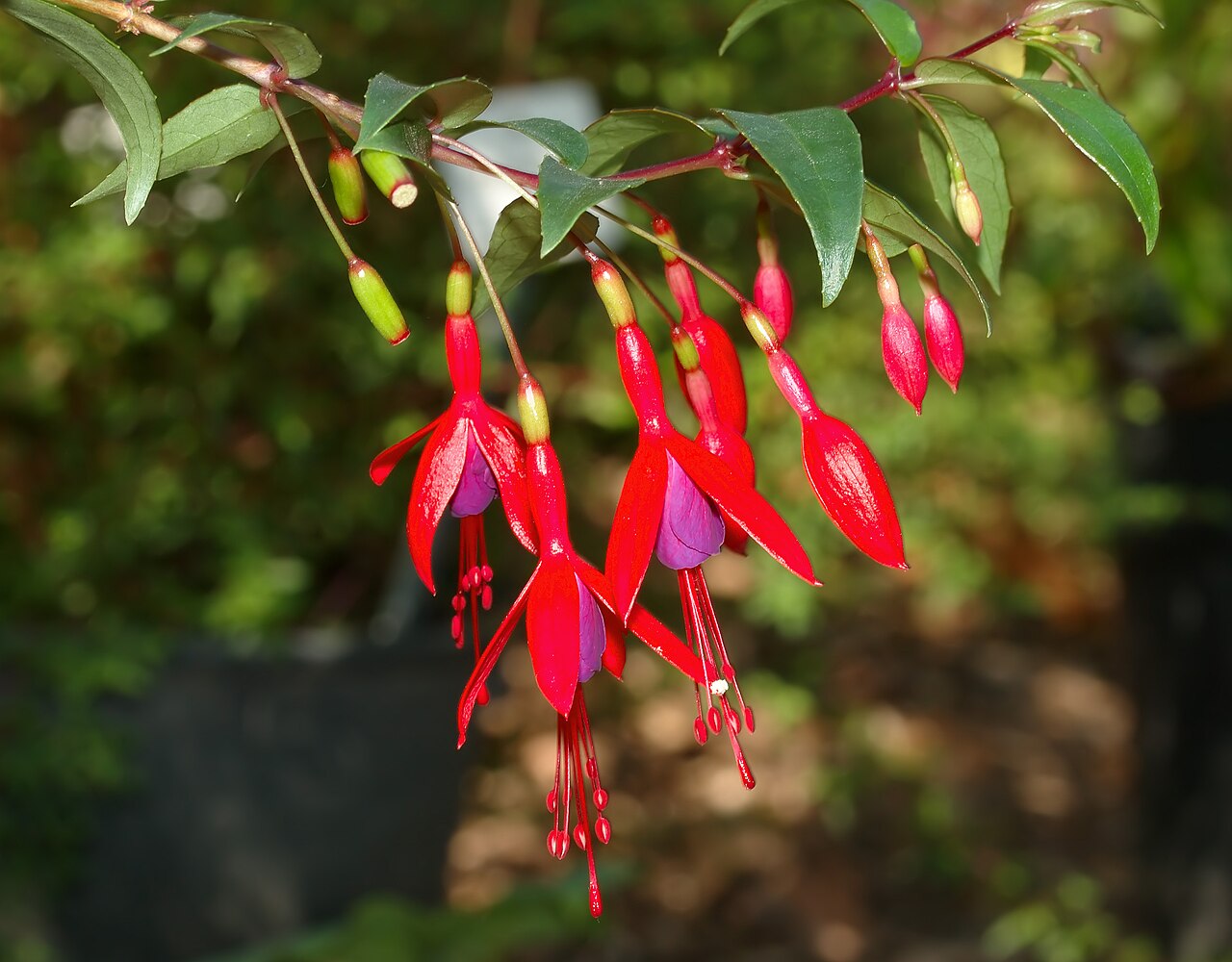
A ballerina from the Andes
Take a close look at a fuchsia flower: four sepals raised like a dancer's arms, a skirt of petals swirling beneath, and long stamens trailing like ribbons. The Dutch call it bellenplant, the bell plant; others see earrings in it. Yet behind this balcony-box silhouette hides a plant with two faces: a shrub that can survive an Ardennes winter in open ground, and a cousin so tender that it suffers at the first frost.
Success with fuchsias comes down to this distinction. Before you water, prune or bring one indoors, you need to know which camp it belongs to. This guide helps you tell them apart, then grow them in our climate, from planting to cuttings.
A genus named after a Renaissance physician
The genus Fuchsia belongs to the evening primrose family (Onagraceae), alongside the evening primroses and willowherbs of our roadsides. It includes just over a hundred species: most recent sources accept close to 110. The vast majority grow in South America, mainly in the humid forests of the Andes, often at altitude where the air stays cool and misty. A few species grow in Mexico and Central America, two on Hispaniola and, as a curiosity of biogeography, three in New Zealand and one in Tahiti.
The fuchsia's European story begins with a monk. Father Charles Plumier, a Minim friar and botanist sent to the Caribbean under Louis XIV, found a scarlet-flowered shrub on the island of Hispaniola (today Haiti and the Dominican Republic) around 1696. In 1703, in his Nova Plantarum Americanarum Genera, he named it in honour of Leonhart Fuchs (1501-1566), a Bavarian physician whose illustrated herbal was a landmark in the history of botany. That first species, Fuchsia triphylla, is still grown today. Linnaeus later adopted the genus name, hence the official author citation "Plum. ex L.".
Living fuchsias, however, only reached Europe at the end of the 18th century: Fuchsia coccinea arrived at Kew in 1788, soon followed by Fuchsia magellanica from southern Chile and Argentina. In the 19th century, English, French and German breeders took them up, and crosses soon numbered in the thousands.
Portrait of a plant designed for birds
The fuchsia you buy at the garden centre is almost always a hybrid (Fuchsia × hybrida in the horticultural sense): a small shrub 30 cm to 1 m tall, with supple stems and opposite or whorled, oval, finely toothed leaves. The hardy species form bushes 1 to 2.5 m tall, and the giant of the genus, Fuchsia excorticata, is a true New Zealand tree that can exceed 12 m.
The flower hangs at the end of a long stalk. What we take for the coloured "tube" and the four upturned points is in fact the calyx: a floral tube and four sepals, often red or pink. Beneath it opens the corolla of four petals (many more in double varieties), in a contrasting shade of violet, white or pink. Eight stamens and a long style protrude. In the wild, this red architecture, usually without scent, is aimed mainly at hummingbirds, which pollinate most species; here, bumblebees know how to make use of it too.
After the flower comes a fleshy berry, dark purple when ripe. It is edible in all the species studied, but very variable: bland in many hybrids, interesting in a few species such as Fuchsia splendens, whose taste is reminiscent of citrus and pepper.
Hardy or tender: the question that decides everything
From a growing point of view, fuchsias fall into two families. Hardy fuchsias derive mainly from Fuchsia magellanica. The Royal Horticultural Society (RHS), for example, rates Fuchsia magellanica 'Riccartonii' H6, meaning it can withstand around -15 to -20 °C in open ground in the UK and northern Europe. Severe cold often kills the top growth, but the rootstock, protected by the soil, sprouts again from the base in spring. In Belgium, these fuchsias make fine border shrubs and even flowering hedges in milder areas.
Patio fuchsias, on the other hand, are tender or barely half-hardy. They flower more, with larger, often double flowers, but cannot take frost and must spend the winter under cover. This applies to most varieties sold for hanging baskets and to the Triphylla group hybrids.
The trap works both ways. A patio fuchsia planted in the ground dies in the first harsh winter; a hardy fuchsia left in a pot is far more vulnerable than in open ground, because the cold reaches its roots through the sides of the container.
Where and when to plant
Fuchsias love soft light and coolness, as in their mountain forests. The ideal spot is in partial shade: morning sun and afternoon shade. Fierce full sun, especially behind glass or against a reflecting wall, scorches the leaves and makes the buds drop. Hardy fuchsias tolerate sun better when the soil stays moist, and the RHS lists 'Riccartonii' for both sun and partial shade. The Triphylla group is the most sun-tolerant, although it too appreciates a little shade in the hottest hours.
In the ground, hardy fuchsias want rich, moist but well-drained soil; they cope equally well with clay, loam or chalk, as long as water does not stand. Plant after the Ice Saints (11 to 13 May), so the plant has the whole summer to root before its first winter. A tip from English gardeners clearly improves survival: set the rootball 5 to 10 cm deeper than it was in its pot, so that buds at the base are sheltered from frost. Allow 50 to 80 cm between plants, and mulch generously.
In pots, choose a container with drainage holes, a good potting compost enriched with a quarter of garden compost, and a spot sheltered from the wind, which easily snaps stems laden with flowers. Patio fuchsias also go outside only after the Ice Saints, after a week of acclimatisation in the shade.
Watering, feeding and pinching: the flowering trio
Fuchsias need regular water. In pots, the rootball must never dry out completely, but must not sit in water either: a saucer that is always full rots the roots. In high summer, that often means daily watering for a hanging basket exposed to wind, every two or three days for a large pot in the shade. Water in the morning or evening, at the base. A fuchsia that wilts in the heat while its soil is moist is not thirsty: it is too hot, and it should be moved rather than watered again.
To flower non-stop from June until the frosts, a patio fuchsia needs feeding. A liquid feed for flowering plants, high in potash, every ten to fifteen days from May to the end of August is enough; stop in September so the stems can ripen before winter. In the ground, a spring application of compost is usually sufficient. Too much nitrogen gives fine foliage and few flowers.
The secret of the bushy fuchsias seen at shows is pinching out. Each time a young shoot has formed two or three pairs of leaves, remove its tip between thumb and forefinger; it then branches in two. Repeated two or three times in spring, this multiplies the stems and therefore the flowers. It delays flowering by about six to eight weeks after the last pinch, so stop around the end of May. In summer, remove faded flowers together with their young fruit, otherwise the plant puts its energy into seeds.
Pruning: in spring, never in autumn
In autumn, resist the urge to cut everything back. On a hardy fuchsia, the dry stems and fallen leaves protect the crown in winter; simply apply a thick mulch at the base (dead leaves, bark, compost) of about 10 cm.
The real pruning is done in spring, when new shoots appear, usually in March-April. On a hardy fuchsia whose stems have been frosted, cut everything back to 10-15 cm above the ground, or just above the buds that are breaking. In sheltered gardens where the framework has not been frosted, you can keep a structure and shorten the branches by only half. On an overwintered patio fuchsia, shorten the previous year's stems by about a third to two thirds, above a pair of well-formed buds, just before growth resumes.
Overwintering patio fuchsias
Patio fuchsias come indoors before the first frosts, usually in October in Belgium, earlier in the Ardennes. Before bringing them in, remove damaged leaves and flowers, and check the undersides of the leaves: whiteflies love to overwinter in the warm with their host.
Two methods work. The first and simplest is a cool rest: a light room between 5 and 10 °C, such as a garage with a window, an unheated conservatory or a lit cellar. The plant loses some of its leaves, which is normal. Water just enough to keep the rootball from drying out completely, about once every three or four weeks depending on temperature. The second is overwintering in a heated, very bright room, where the fuchsia keeps growing; this is trickier, as dry air and poor light make it leggy and attract pests.
In March, repot in fresh compost, prune, then gradually increase watering. The plant can start again in a bright, sheltered place and only goes outside after the Ice Saints.
For general overwintering advice for the garden, see also our guide Overwintering garden plants (in French).
Cuttings: child's play
Fuchsias are among the easiest plants to propagate from cuttings, and it is the best way to keep a tender variety in case the mother plant is lost. Softwood cuttings are taken in spring (April-May) from young new shoots, or at the end of summer (August-September). Cut a non-flowering shoot tip of 5 to 10 cm, with two or three pairs of leaves, just below a node. Remove the lowest pair of leaves and any buds, then insert it into an equal mix of compost and sand or perlite.
Under a mini-greenhouse or a clear plastic bag, in light but out of direct sun and at around 18 to 20 °C, roots appear within three to four weeks. Rooting in a glass of water also works very well. Seed sowing is possible but does not reproduce the variety: seeds from a hybrid give plants different from their parent, which delights collectors hoping to create their own varieties.
Pests and diseases: what to watch for in Belgium
Whiteflies, those tiny white insects that fly up in a cloud when the plant is shaken, are the main enemies of patio fuchsias, especially under cover. Yellow sticky traps reduce their numbers; in a greenhouse or conservatory, the parasitic wasp Encarsia formosa is effective. Aphids distort young shoots in spring, and red spider mite yellows and dulls the leaves in hot, dry weather, especially in pots: higher humidity slows it down. Finally, vine weevils notch the leaf edges, but it is their larvae that kill potted fuchsias by eating the roots during winter; entomopathogenic nematodes applied to the compost at the end of summer deal with them.
As for diseases, fuchsia rust (Pucciniastrum epilobii) forms orange pustules under the leaves, which yellow and drop; remove and discard affected leaves and avoid wetting the foliage. Grey mould (Botrytis) attacks flowers and stems in damp, stuffy conditions, especially during overwintering: ventilation and clearing dead leaves are the best prevention.
One last pest is worth knowing: the fuchsia gall mite (Aculops fuchsiae), invisible to the naked eye, which distorts shoots into swollen, reddish masses. According to the European and Mediterranean Plant Protection Organization (EPPO), it was detected in Belgium in 2012 in a collection near Antwerp, then declared eradicated in 2014, and EPPO reports no new Belgian finding since. It is, however, present in the Netherlands and France. So be careful with cuttings brought back from abroad: if in doubt, a distorted plant should be reported to the Belgian Federal Agency for the Safety of the Food Chain (FASFC) rather than added to the collection.
Seven varieties to start with
Among the hardy fuchsias, Fuchsia magellanica 'Riccartonii' is the benchmark: a vigorous shrub of 1.5 to 2.5 m, with small flowers with a crimson calyx and violet corolla, rated H6 and holder of the RHS Award of Garden Merit; it makes excellent informal hedges. 'Mrs Popple', also vigorous (around one metre), bears large single red and violet flowers. 'Hawkshead' stands out with its pure white flowers, elegant in shade. 'Genii' is chosen for its golden foliage, which lights up a dark corner, with cherry-red and violet flowers.
For pots and hanging baskets, 'Swingtime' is a trailing classic with large double red and white flowers. 'Dollar Princess', more compact, bears rows of small double red and dark violet flowers. Finally, the Triphylla group hybrids, such as 'Thalia', recall the species discovered by Plumier: velvety red-bronze foliage and long tubular orange-red flowers in clusters at the stem tips. These tolerate sun better than other fuchsias, but are among the most tender.
Toxicity, ecology and little secrets
Good news for homes with pets: the ASPCA, the American animal poison control centre, lists fuchsia (Fuchsia triphylla entry) as non-toxic to dogs, cats and horses, and the genus is not known to be toxic to humans. The flowers are even used to decorate salads and desserts, and the berries are edible: in that case, choose plants grown without pesticides.
Ecologically, Fuchsia magellanica has naturalised in places in mild oceanic regions, notably along the coasts of western Ireland and the British Isles, where it lines roads with scarlet hedges. It is not considered invasive in Belgium. Its flowers feed bumblebees late in the season, when resources are becoming scarce.
Did you know? The colour "fuchsia", that vivid pink-purple, is named after the flower, not the other way round: so, indirectly, a 16th-century Bavarian physician gave his name to a colour. As for the largest fuchsia in the world, New Zealand's kōtukutuku (Fuchsia excorticata), its bark peels in papery strips and its flowers turn from purple-tinged green to red as they age.
Sources
- Royal Botanic Gardens, Kew, Plants of the World Online, "Fuchsia Plum. ex L.", powo.science.kew.org
- Royal Horticultural Society, "Fuchsia magellanica 'Riccartonii'" plant profile, rhs.org.uk
- ASPCA Animal Poison Control, "Honeysuckle Fuchsia (Fuchsia triphylla)", aspca.org
- EPPO Global Database, "Aculops fuchsiae — distribution in Belgium", gd.eppo.int
- Fuchsias Delhommeau, "History of Fuchsia" (Plumier's discovery and 1703 publication), fuchsia-delhommeau.com
- Wikipedia, "Fuchsia" (number of species, distribution, introduction at Kew), en.wikipedia.org