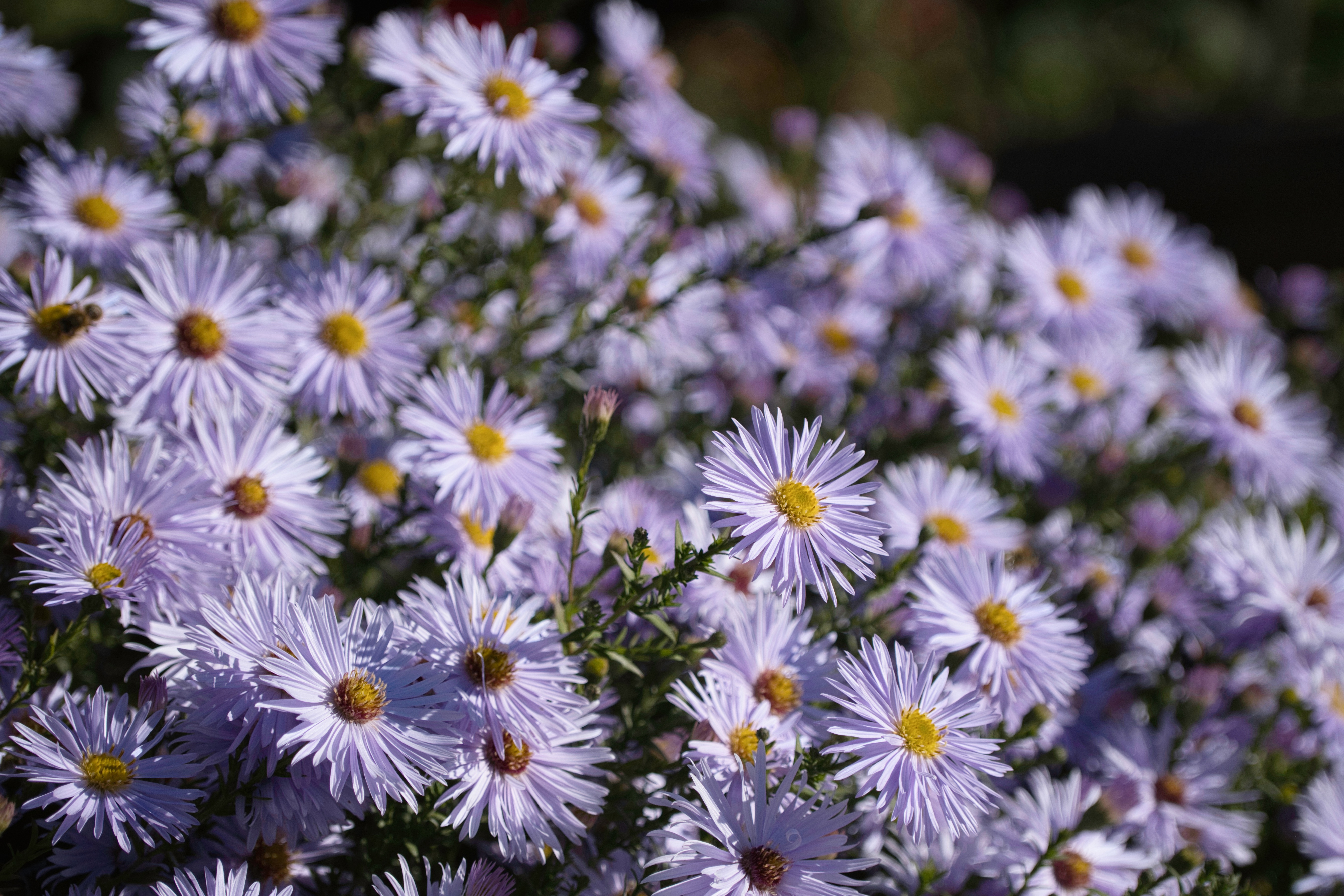
Autumn asters — A complete guide to growing and using them
When September starts casting its slanted light over the borders, autumn asters take the stage. They have waited their turn while the roses paraded and the dahlias unfurled their velvet blooms. Then, just as the garden seems ready to slowly close its eyes, their countless blue, mauve, pink or white stars light up at the top of their stems.
Their name comes from the Greek astḗr, "star," and it seems tailor-made for them. Each flower looks like a small radiant star gathered around a yellow heart. Yet what your eye perceives as a single flower is in fact a flower head made up of a multitude of tiny florets, packed tightly together, following the characteristic architecture of the daisy family (Asteraceae).
Behind the familiar name "aster" now hides a whole botanical constellation. Modern classifications have moved many American species once placed in the genus Aster into genera such as Symphyotrichum and Eurybia. The famous "New York aster," once called Aster novi-belgii, now carries the accepted name Symphyotrichum novi-belgii. Despite these changes, gardeners naturally keep talking about asters, a common name that's far easier to slip in between two rows of perennials. (powo.science.kew.org)
An army of flowers against September's melancholy
Most autumn asters are hardy perennials. Each winter, their above-ground parts disappear, but their crown remains tucked away underground, ready to send up new stems as soon as spring returns. Depending on the species and variety, these stems can form a compact 30 cm cushion or a veritable flowering wall well over a metre tall.
Symphyotrichum novi-belgii, the New York aster, generally produces dense, heavily branched clumps with generous flowering. Despite its enchanting name, it is not native to Belgium: its natural range stretches from eastern Canada to the north-eastern United States. It has, however, been introduced and has naturalised across many European regions, including Belgian territory. (powo.science.kew.org)
Its cousin, Symphyotrichum novae-angliae, the New England aster, often has a sturdier silhouette. Its upright stems and rough leaves bear purple, mauve or pink flower heads whose yellow discs gradually darken. Under good conditions, some forms can reach between 90 cm and nearly 1.80 m, while compact cultivars stay obligingly in the front of the border. (missouribotanicalgarden.org)
Alongside them, European asters such as Aster amellus generally prefer better-drained soils, while Eurybia divaricata, with its fine white stars, copes better with the filtered light at the edge of woodland. This diversity means there's an aster for almost every spot in the garden, from a sunny border to a lightly shaded edge.
The pollinators' autumn feast
An aster in full bloom looks like a small aerial town. Bees work there with feverish diligence, hoverflies hang suspended above the flower heads like tiny helicopters, and butterflies open their wings on the flowers to soak up the season's last warmth.
This late flowering is a precious resource once many other perennials have already finished their cycle. Asters still offer nectar and pollen to insects active in late summer and autumn. The Royal Horticultural Society even lists Symphyotrichum species and hybrids among the plants of interest for pollinators. (rhs.org.uk)
To turn your border into an autumn banquet, pair asters with sedums, eupatoriums, heleniums, Japanese anemones and ornamental grasses. The asters will form the stars of the display while the plumes of Miscanthus, Panicum or Molinia catch the light like copper-coloured hair. Avoid tidying up the whole border too early, though: faded flower heads and dry stems retain a lovely presence through winter and offer shelter to discreet small wildlife.
Planting the aster in the right spot
Most autumn asters bloom most abundantly in full sun. Light shade is still acceptable, but the less light there is, the more the stems tend to stretch and the sparser the flowering becomes. Bright exposure, combined with good air circulation, also helps limit certain foliage diseases.
The ideal soil is fertile, humus-rich and moist during the growing season, without staying waterlogged in winter. Symphyotrichum novi-belgii has a relatively shallow root system and particularly appreciates soil that retains consistent moisture. In light or sandy Belgian soil, a layer of well-rotted compost applied in spring acts as a protective sponge: it feeds soil life and slows evaporation. European and Asian asters, on the other hand, often cope better with drier ground and mainly need efficient drainage during the wet season. (rhs.org.uk)
Early spring, from March to early May, is an excellent time to plant. The crown then has several months to root in before its first flowering. A container-grown plant can be planted later, provided the ground is neither frozen nor waterlogged and you keep a close eye on watering over the following weeks. (rhs.org.uk)
Dig a hole wider than the root ball, loosen the soil carefully and work in a little well-rotted compost. After planting, water slowly and deeply. Generous but infrequent watering encourages the roots to go down, while a series of small, shallow sprinklings keeps them dangerously close to the surface.
Taming the giants without breaking their momentum
Some asters grow over a metre tall and become vulnerable to heavy rain and September gusts. Their stems, laden with hundreds of flower heads, can then bend over or splay open like an overripe sheaf. Put supports in place before midsummer, while the surrounding growth can still hide them naturally. Branching twigs, discreetly pushed into the clump, often give a more elegant result than a rigid stake put in after the damage is done. (rhs.org.uk)
You can also apply an early-summer pruning comparable to the British "Chelsea chop." By cutting back some of the stems towards the end of May or early June in the Belgian climate, you generally get a bushier, shorter and slightly later-flowering plant. This technique works particularly well with many Symphyotrichum novi-belgii cultivars, though the result varies with variety, soil and weather conditions. You don't necessarily need to cut back the whole clump: by shortening only the stems at the front, you can create several tiers of flowering.
Deadhead faded flower heads if you're after a neat look and prolonged flowering. If your garden leans more towards the naturalistic, let the last flowers develop freely. Their brown silhouette will stay decorative under frost and will keep the border from turning into bare ground over winter.
Powdery mildew, that white veil on the leaves
The most familiar enemy of asters, particularly Symphyotrichum novi-belgii, is powdery mildew. This fungus covers the leaves with a greyish-white felt, as if the plant had passed through a cloud of flour. It appears more readily when the roots are suffering from drought, when clumps are too crowded, or when air circulates poorly around the foliage. (rhs.org.uk)
Prevention therefore starts underground. Maintain consistent moisture, apply an organic mulch in spring and avoid planting asters right up against one another without breathing room. Water directly at the base rather than over the foliage, and divide old clumps that have become congested. Some cultivars also prove less susceptible than others; this is a criterion worth considering in a garden where mildew returns every year.
A lightly affected plant can keep flowering. It's therefore not always necessary to declare chemical war. Remove badly diseased leaves, improve growing conditions and clear away heavily contaminated debris at the end of the season.
Dividing the clump to renew its youth
Over the years, many asters form a dense crown whose centre eventually becomes exhausted. Flowering then shifts to the outer edge while the heart turns woody, sparse or nearly empty. Every three to five years, in early spring, lift the clump and split it into several vigorous fragments. Keep preferably the young sections from the outer edge and replant them immediately in enriched soil. This division rejuvenates the plant while faithfully reproducing the cultivar. (rhs.org.uk)
Botanical species can also be propagated from seed, but seeds from hybrid cultivars produce variable offspring. This unpredictability can become an exciting adventure if you like surprises, but it won't reproduce exactly the colour or shape of the parent plant.
A beauty to keep an eye on near natural habitats
The vigour of asters is both their superpower and their contradiction. Some North American species that have escaped from gardens can naturalise in wasteland, riverbanks and damp meadows across Europe. In Belgium, several former "asters" are recorded among the exotic plants observed outside cultivation, notably Symphyotrichum lanceolatum, S. novi-belgii and S. novae-angliae. Species still belonging to the genus Aster in the strict botanical sense appear, for their part, to naturalise far less readily. (alienplantsbelgium.myspecies.info)
This situation doesn't condemn all garden asters, but it does call for gardening with discernment. Near a nature reserve, a river, a damp meadow or a site where green waste risks being scattered, favour well-behaved cultivars and watch out for suckers or spontaneous seedlings. Never dump rhizome fragments in the wild: even a small piece of crown can sometimes become the first chapter of a quiet colonisation.
The stars that close the season
Growing autumn asters means refusing to let September be merely a month of departure. Their flowers extend the colour, feed the insects and give borders that particular depth found in gardens that have reached maturity. They don't have the motionless perfection of a greenhouse flower; they move with the wind, mingle with the grasses and gather a whole population of wings around them.
Plant them where the sun can still reach them at the end of the day. When their flower heads become covered in bees and their purple hues seem to hold onto the dusk, you'll understand why gardeners forgive them their complicated botanical names. In the end, it hardly matters whether we call them Aster, Symphyotrichum or Michaelmas daisies: on the threshold of winter, they relight the sky at eye level.
Sources and references
Royal Horticultural Society, "How to grow Asters" and the general guide to the genus Aster, accessed September 2026. (rhs.org.uk)
Royal Botanic Gardens, Kew, Plants of the World Online, taxonomic records for Symphyotrichum novi-belgii and its synonym Aster novi-belgii, accessed September 2026. (powo.science.kew.org)
Missouri Botanical Garden, Plant Finder, entry for Symphyotrichum novae-angliae, accessed September 2026. (missouribotanicalgarden.org)
Manual of the Alien Plants of Belgium, taxonomic treatment of former members of the genus Aster in Belgium, accessed September 2026. (alienplantsbelgium.myspecies.info)